
In an international coup, Adelaide is the first stop on a world tour of the exhibition, Treasures of the Viking Age: The Galloway Hoard, and it will be the very first time this precious collection of objects has ever travelled outside the United Kingdom.
DATES & DEETS
- 08 FEB – 27 JUL
- Adelaide SA
- www.samuseum.sa.gov.au
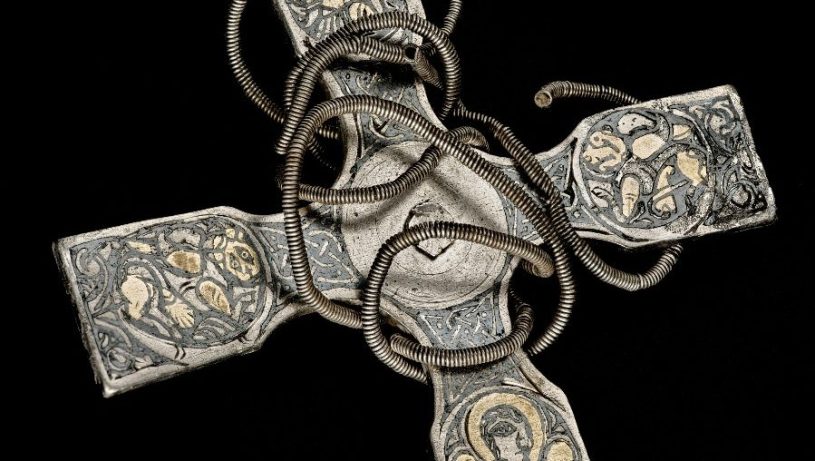
The Galloway Hoard is the richest find of rare and unique Viking-age objects ever made in Britain or Ireland. Buried around AD 900 and only discovered in 2014 in southwest Scotland, the Hoard contains a stunning variety of objects and materials buried together at one time.
Dr Martin Goldberg, principal curator of Medieval Archaeology & History at National Museums Scotland, said: “The Galloway Hoard has repeatedly drawn international attention since its discovery and acquisition by National Museums Scotland.”
“But this hoard was in many respects a journey into the unknown, and the exhibition presents all the amazing discoveries we have made through our research. We’re delighted the exhibition can now be seen by audiences outside the UK, a once-in-a-lifetime opportunity to experience these exceptional objects in person.”
Dr David Gaimster, CEO of South Australian Museum, said: “The Galloway Hoard is a rich collection in every sense, from rare and unique examples of gold and silver work that shows the artistry of the period to items of hacked bullion that show the intensity of trade and exchange. Taken together, this hoard challenges popular understandings of this period in world history. Indeed, the Hoard reveals the extensive networks of trade and exchange that stretched from Scandinavia and the Atlantic across to Central Asia and the Silk Routes.
“We are delighted to partner with National Museums Scotland to bring the Galloway Hoard halfway across the globe for Australian audiences to experience up close – a turn of events the Hoard’s original owners could scarcely have imagined.”
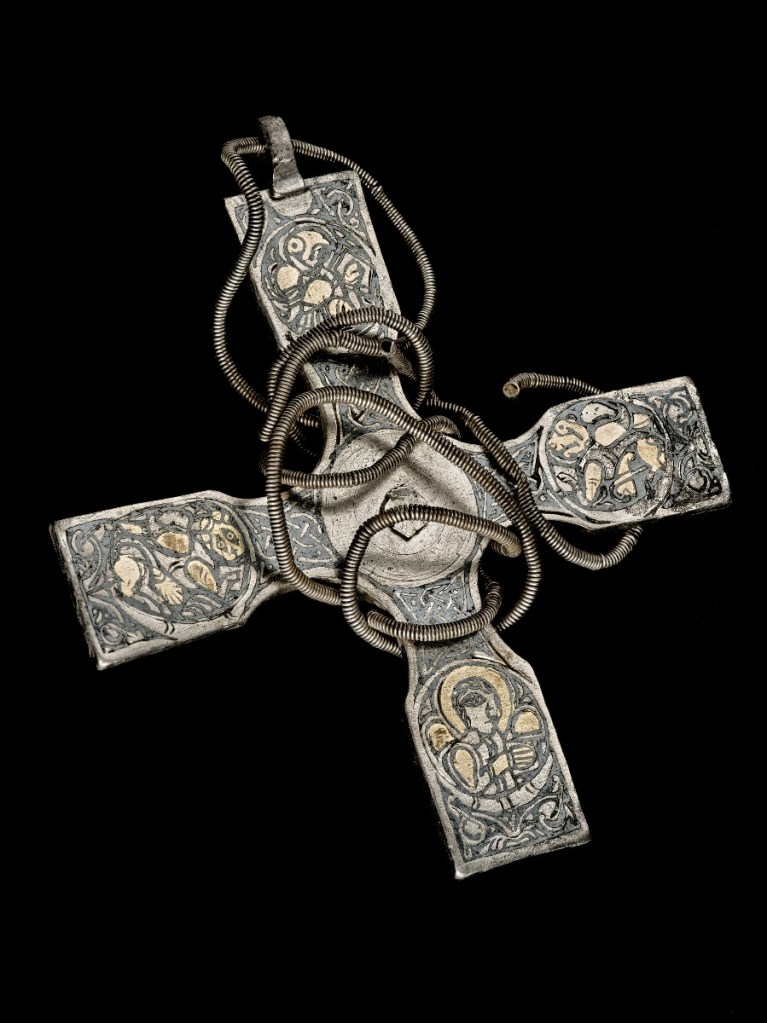
The exhibition shows how the Hoard was buried in four distinct parcels and as the visitor is drawn further into this ancient world each parcel becomes richer and more unusual. The top layer was a parcel of silver bullion and a rare Anglo-Saxon cross, separated from a lower layer of three parts: firstly, another parcel of silver bullion wrapped in leather and twice as big as the one above; secondly, a cluster of four elaborately decorated silver ‘ribbon’ arm-rings bound together and concealing in their midst a small wooden box containing three items of gold; and thirdly, a lidded, silver gilt vessel wrapped in layers of textile and packed with carefully wrapped objects that appear to have been curated like relics or heirlooms. They include beads, pendants, brooches, bracelets, relics and other curios, often strung or wrapped with silk.
Decoding the secrets of the Galloway Hoard has also been a multi-layered process. Decorations, inscriptions, and other details hidden for over a thousand years have been revealed through careful conservation, painstaking cleaning, and cutting-edge research by a team of experts led by National Museums Scotland. Conservation of metal objects has revealed decorations, inscriptions, and other details that were not previously visible.
Many of the objects are types that have never been seen before in Britain and Ireland. Some had travelled thousands of miles to reach Scotland. Some items are too fragile to travel long distances, particularly those which still have rare traces of textiles that have survived for more than 1,000 years. The exhibition will employ audio-visual and 3D reconstructions to enable visitors to experience these objects and learn more about the detailed research that is being done.
In a surprising twist, the South Australian Museum has also uncovered two Viking-Age pieces in its own collection of world cultures material, and they will also go on display for the first time to coincide with the exhibition.
A private collector from Sweden, Bertil Gunnarsson-Hagman, donated two brooches from Gotland to the Museum after settling in Adelaide during the 1940s. The Swedish Island of Gotland occupied a strategic position in Viking Age trade networks. The bronze women’s brooches would have originally been flashy fashion accessories, gilt in gold and silver to highlight the intricate metalwork. Authentic Viking-Age items like this are rarely found in Australian museum collections.
Picture: An Anglo-Saxon cross from the Galloway Hoard, which will go on public display in Adelaide. Credit: South Australian Museum

