
Palaeontologists in Ireland have just made a sizzling discovery: they’ve found the first-ever molecular evidence of phaeomelanin, the pigment that gives gingers their fiery hair, in the fossil record.
They’ve discovered 10-million-year-old frogs with the same kind of pigment that gives modern-day gingers their distinctive hue.
This groundbreaking study was led by Dr Tiffany Slater and Prof. Maria McNamara of at University College Cork’s School of Biological, Earth, and Environmental Sciences. They teamed up with scientists from Japan, China, and Sweden to make this awesome find.
Dr Slater said: “This finding is so exciting because it puts palaeontologists in a better place to detect different melanin pigments in many more fossils.
“This will paint a more accurate picture of ancient animal colour and will answer important questions about the evolution of colours in animals. Scientists still don’t know how – or why – phaeomelanin evolved because it is toxic to animals, but the fossil record might just unlock the mystery.”
Ginger hair, caused by a variant of the MC1R gene, is found in about 1-2% of the global population. The highest concentrations are in Scotland, where around 13% of people have red hair, and Ireland, where about 10% are redheads.
The gene is recessive, meaning both parents must carry it for their child to have ginger hair.
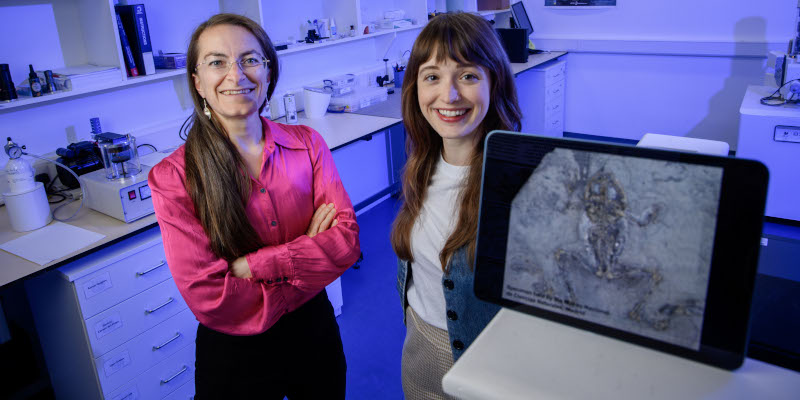
Picture: Prof Maria McNamara and Dr Tiffany Slater pictured at the School of Biological, Earth and Environmental Sciences at University College Cork. Credit: Daragh Mc Sweeney/Provision
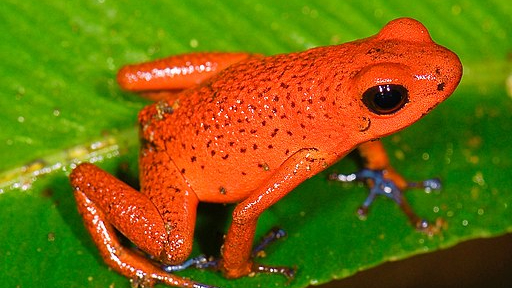
Cover picture: Oophaga pumilio (Strawberry poison frog). Credit: Marshal Hedin from San Diego, CC BY 2.0 https://creativecommons.org/licenses/by/2.0, via Wikimedia Commons

