
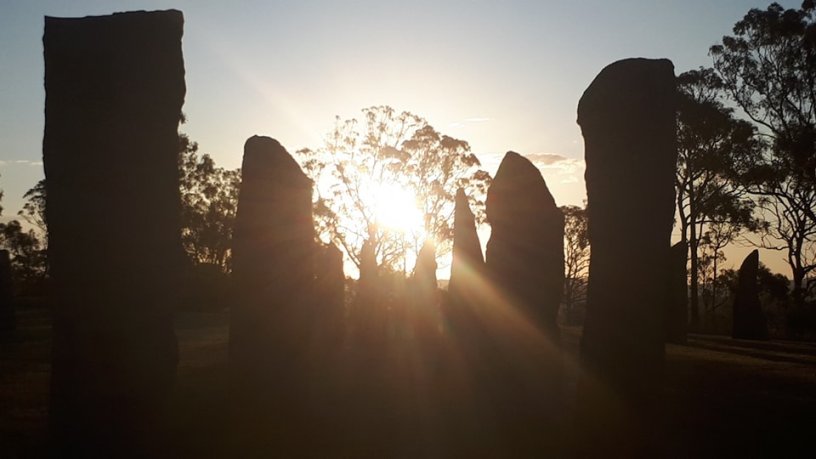
Sunrise on the Summer Solstice at the Australian Standing Stones. Picture: John Rhys Jones/Australian Standing Stones Management Board
Glen Innes, a picturesque town nestled in the Northern Tablelands of New South Wales, is set to host an enchanting celebration at the Australian Standing Stones this December. As the 2023 Summer Solstice approaches, an ancient and sacred tradition awaits, providing locals and visitors with an opportunity to connect with Celtic heritage and the rhythms of the sun.
The Australian Standing Stones pay tribute to the rich Celtic origins that have woven their way into the tapestry of Australian life. As the early Celtic people developed in the European homelands, the ancient standing stone monuments served as calendars to mark the time for sowing and harvesting, but also as abodes of rich myth and legend, and were centres to celebrate the movements of the sun and moon. People of the Celtic homelands dispersed worldwide, including to Australia. Glen Innes, in particular, has a deep-rooted connection to its Celtic heritage, with its first European settlers predominantly hailing from Scotland, as well as from Ireland, Wales, and Cornwall.
The idea for the Australian Standing Stones was ignited by the Celtic Council of Australia, aiming to establish a national monument to honour all Celtic pioneers who played a significant role in shaping Australia. The monument, inspired by ancient sites like the Ring of Brodgar and the Callanish Stones, were dedicated in 1992, becoming a testament to Australia’s unique blend of cultures.
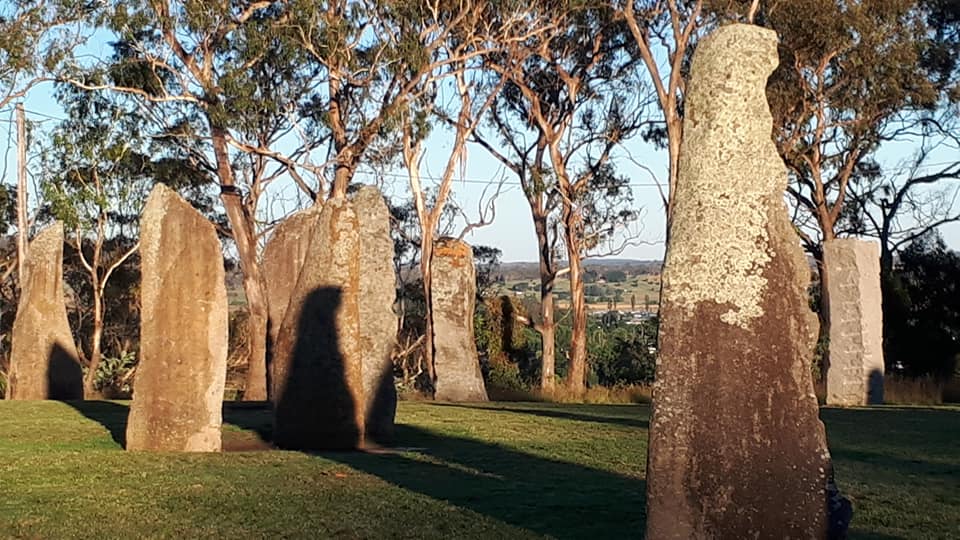
The Australian Standing Stones consist of 38 stones, including a circle of 24, symbolising the 24 hours of a day. Central to the monument are three stones representing all Celts.
The central stone, the Australis Stone, is for all Australians and symbolises the link between the old and new worlds.
The Gaelic Stone, to its north, is for Scotland, Ireland and the Isle of Man.
The Brythonic Stone, to its south, is for Wales, Cornwall and Brittany.
The magic happens on solstice days, the shortest and longest days of the year. At dawn, the sunrise is marked by special stones; at sunset by other marker stones. These are special times to visit and experience the alignments at the monument. At solar noon, when the sun is highest in the sky, visitors can witness the shadows cast by the stones that mark these celestial events, providing a unique blend of science and tradition. The Australian Standing Stones become a living calendar, connecting us to the movements of the Earth and the sun.
If you visit during the 2023 Summer Solstice, you’ll experience the day with the most daylight hours of the year, typically occurring on December 21st. The ceremony begins at 12.30pm often accompanied with a piper, leading up to the moment of solar noon, where an informative talk sheds light on the stones’ solar noon measurements, and there are fundraising prizes to win as well. You can also become the shadow marker of the human sundial right beside the solar noon array.
At dawn, the Summer Solstice sunrise stone, within the circle to the southeast of the central Australis Stone, receives the sun’s first rays at dawn on the summer solstice, and casts a shadow onto the Australis Stone. At dusk, the last rays of the sun shine back down the Winter Solstice sunrise avenue, linking the two solstices at the end of day.
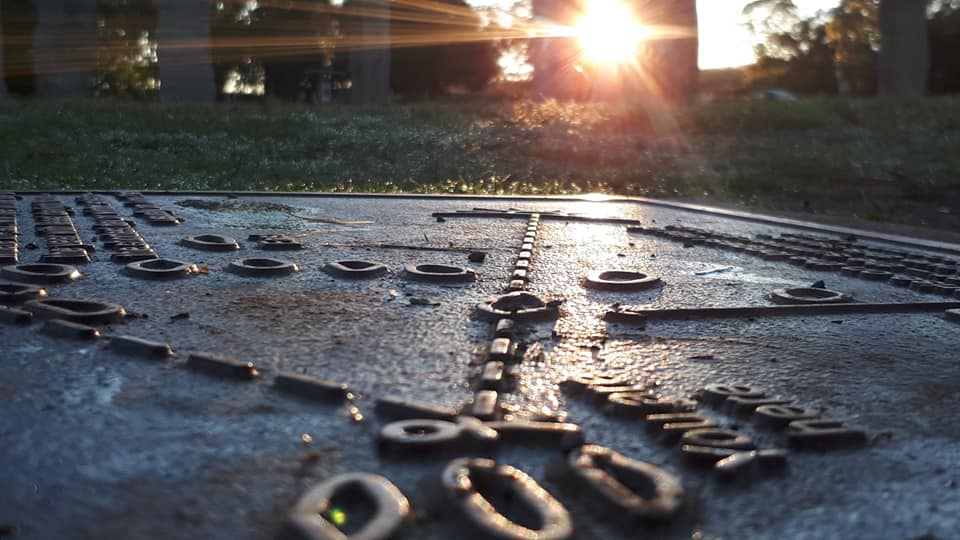
One stone hosts seven ground-level plaques marking the annual movement of the earth around the sun by depicting the changing length of the sun’s shadow at solar noon throughout the year.
The four cardinal point stones, together with the Summer Solstice sunrise stone, depict the five stars of the Southern Cross, while the four cardinal point stones and the circle of 24 form a Celtic cross: and so together a Southern Celtic Cross.
Looking south outside the array is the distinctive flat stone – the Gorsedd Stone. Requested by the Welsh and Cornish communities, this ‘Throne’ Stone evokes Bardic festivals, Eisteddfods, where winners or ‘bards’ were installed on a stone stage symbolised by this stone.
To the east of the Gorsedd Stone is the tall, squarish stone – the Ogham Stone. This Stone was requested by the Irish community and is the heaviest stone at 38 tonnes. The inscription on the square edges consists of short, long and sloping lines in the Ogham alphabet , known from inscriptions dating to the 4th century AD.
The Ogham inscription translates into Gaelic as Gleann Maqi Aongusa, meaning ‘the Glen of the Sons of Angus’ or Glen Innes.
Tynwald Hill, on the hill to the south, acknowledges the Isle of Man, and Tynwald – the longest continually-serving parliament in the world.
To the north of the Stones is The Hill of Tara, as a tribute to the ancient seat of the high kings of Ireland, and from where the Australian Standing Stones flag flies to greet visitors.
The ancient Celts celebrated these solstice events, and today, their descendants carry on this timeless tradition, embracing the longest day of the year and the rich tapestry of Celtic heritage.
So, make your way to the Australian Standing Stones in Glen Innes this December, where ancient traditions and the modern world come together in harmony. Experience the enchantment of the 2023 Summer Solstice, connecting with Celtic history and the natural world at its zenith. It’s an experience that promises to be both enlightening and magical.
While at the Australian Standing Stones, you can also try to lift Excalibur from the stone, check out the Celtic Family Wall, and relax with refreshments at The Croft Celtic Cultural Centre and Cafe that occupies Crofter’s Cottage, a tribute to Scottish ‘taigh dubh’ (traditional thatched cottage).
Take a drive or walk to Martin’s Lookout (400m south) for a stunning view of the town at the newly-
installed Skywalk.
The Summer Solstice gathering at the Australian Standing Stones takes place on Thursday, 21st December 2023 from 12.30pm to 1.30pm. Watsons Drive, Glen Innes, NSW 2370. For more information, contact (02) 6730 2400 or email tourism@gisc.nsw.gov.au. This is a free public event.
*This article was first published in the December 2023 edition of Anglo&Celtic magazine

