
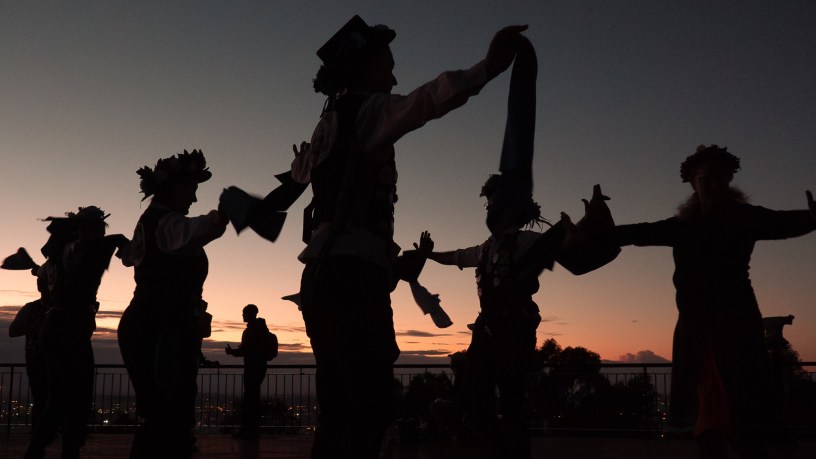
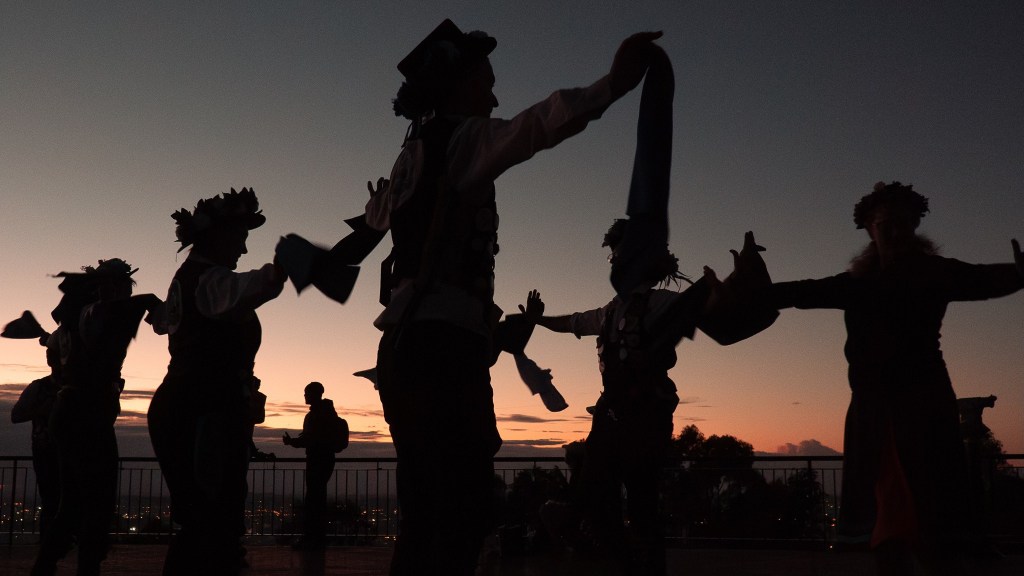
As the British Isles welcome summer with dancing around the Maypole and fire festivals, Australia too will be marking May Day with both Anglo and Celtic traditions.
At dawn on the first day of May, Morris dancing sides across the world gather, usually at a high point like a mountain or hill, to dance up the sun and welcome the Northern Hemisphere Summer. This year, sides from all across Australia will be gathering to honour the tradition.
The Morris dancers of Brisbane, QLD, will gather on Mt Coot-tha on May 1 to dance up the sun, a tradition they’ve held for decades. They meet 5:20am (5:30am start) at Mt Coot-tha lookout for dancing in the dark, followed by true dawn around 6:14am, with a BBQ immediately after at the J.C. Slaughter Falls picnic area. For more details, see Belswagger Morris’s Facebook Event.
Meanwhile in Canberra, ACT, Surly Griffin Morris will gather at Mt Ainslie. The Morris side shared: “Keep the world turning and the sun rising for another year with Morris Dance on a Mountain for May Day. Join Surly Griffin and our fellow Canberra Morris side, Limestone , dancing atop Mt Ainslie, followed by breakfast at Braddon and more dancing.” The fun begins at 6.15am and you can check out more details at the Facebook Event page.
In Perth, WA, Marlee Morris invite you join them at Kaarta Gar-Up Kings Park in Perth at 8.30am to dance up the sun. They shared: “Come and join us on our annual contribution to the wellbeing of the earth as we ensure the sun rises on May Day (start of Northern Hemisphere Summer, they need all the help they can get). We will be guests of the mighty Perth Morris Men and hope to meet with our friends The Fair Maids of Perth and Mad Tatters Morris.” Further details at their Facebook Event.
All three Melbourne Morris sides (Brandragon, Britannia, and Red Raven) will dance up the sun in Victoria. They shared: “May Day is an important Morris dancing occasion. Across the world, Morris dancers dance up the sun on 1 May, signalling the traditional beginning of the Northern Hemisphere summer. Please join us for a very special sunrise and bring a snack to share afterwards! May Day is a beautiful day of community. We can’t wait to see you!” Join them at All Nations Park, 56 Brickworks Ln, Northcote, at 6am. Further info is at their Facebook Event page.
In Sydney, Black Joak Morris will You are invited to join us to dance up the sun at 05:30am at Observatory Hill Rotunda, 3 Watson Rd, Millers Point, Sydney. The side shared: “We will welcome in the sun, and then have a breakfast together. As the tradition goes, unless the Morris dance in the early dark of May 1st, the sun wont rise. So come and cheer us on, as we herald the beginning of the cool. This tradition comes from the northern hemisphere and is shared across some cultures as, amongst many things, the coming of summer, midway between the spring equinox and summer solstice. We are sharing this tradition with our northern Morris cousins, bouncing the warm sun their way, while ourselves welcoming in the lovely cooler months and celebrating the end of the festival season. May Day also commemorates those who struggled to win the right to fair pay and an eight-hour day, and we honour this as well. For many years this has been our private ceremony, but we would love to invite our folk friends to this special time this year.” Further details at AllEvents.
In Tasmania, join the Jolley Hatters Morris in welcoming the dawn with music dance in solidarity with Morris dancers worldwide. They’ll be welcoming the dawn at beautiful Mount Wellington from 6.30am. The side shared: “Wear as many clothes as you can. The weather forecast is cold and reasonably calm. It’s a memorable event that has been celebrated since the founding of our team in 1986. Merry May!”
Details are at their Facebook Event.
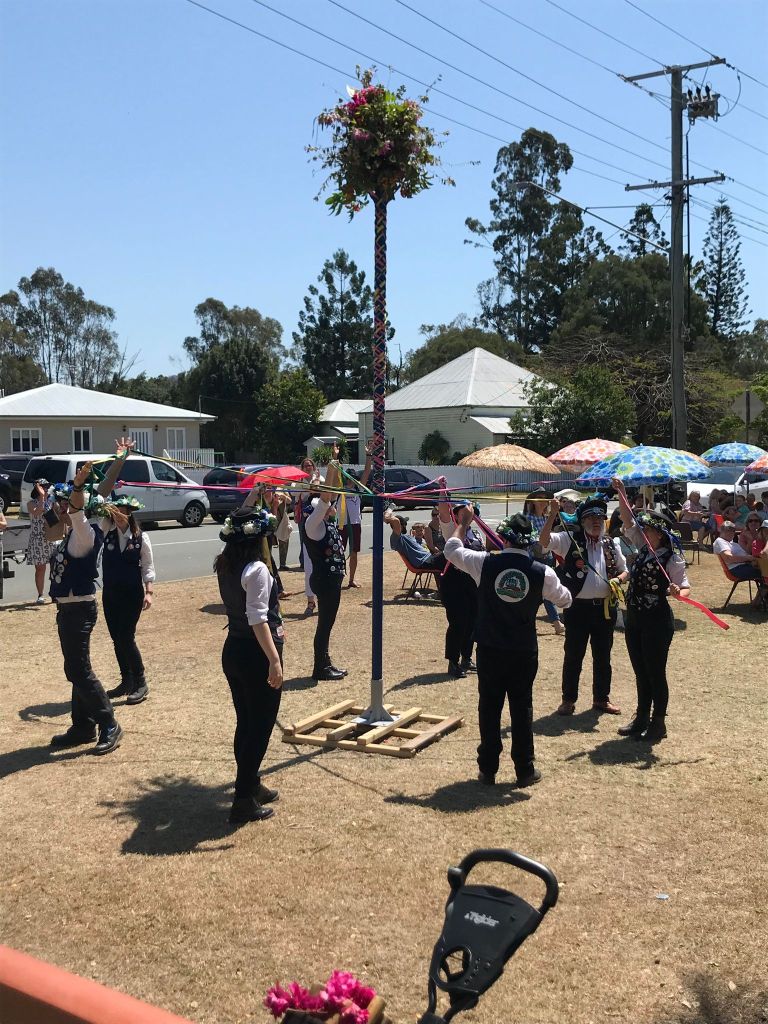
Dancing around the Maypole is a traditional folk dance that dates back centuries and is very much associated with English May Day celebrations. It is believed to have ancient pagan roots linked to fertility rituals.
The Maypole, typically a tall wooden pole decorated with ribbons, flowers, and greenery, symbolises the renewal of life and the awakening of nature after winter.
The dance itself involves participants, often young men and women, weaving in and out around the Maypole, each holding onto a ribbon attached to the top of the pole. As they move in opposite directions, the ribbons become intertwined, creating intricate patterns on the pole.
Once a common practice here in Australia, Maypole dancing has largely died out. One of the last Maypoles left standing in Australia is at the New South Wales Schoolhouse Museum of Public Education in North Ryde.
Gaye Braiding, Education Officer at the museum, told Anglo&Celtic: “We use a reproduction Maypole for our education program made from some re-purposed materials. To our knowledge, maypole dancing ceased as an activity in NSW public schools probably around the early 1980s. Prior to that there were booklets issued to teachers with instructions on the dances and weaving of ribbons.
“From the photographs we have seen, the ‘hey-day’ of maypole dancing in NSW public schools, and community events involving schools, seems to be between about 1870 and the 1940s.”
Westbury in Tasmania also has a Maypole. It is a permanent structure on the village green. The local school children dance around the Maypole during St Patrick’s Day celebrations.
While May Day is widely celebrated across England with Maypole dancing and crowning of the Queen of May, the practice is not as common in the Celtic nations. But one village in Ireland bucks the trend.
The Queen of the May is practiced in the County Cork seaside village of Whitegate.
The May Queen is a girl who rides or walks at the front of a parade on May Day. She wears a white gown to symbolise purity and often has a crown of flowers.
In Whitegate, young girls go ‘garlanding,’ or flower-gathering, in preparation for their Queen of the May procession, which takes place on the first Sunday in May. The tradition is thought to have been brought by British soldiers stationed at nearby Fort Carlisle in the 1800s.
At Whitegate National School, girls gather wildflowers to decorate the May bough, a mature, horseshoe-based briar and a traditional centrepiece for the parade. The May Queen, chosen from the previous year’s First Communion class, leads a procession through the village in her Communion dress, followed by local schoolgirls. They sing May songs and collect donations.
While the worship of the Goddess of Summer is at the root of the old May-time rituals, in Ireland, this evolved into Catholic Marian processions and May altars filled with flowers to worship Mary.
Now, ancient Celtic pagan festivals such as Beltane (Scotland, Isle of Man), Calan Mai (Wales) and Bealtaine (Ireland) are enjoying a resurgence.
Beltane is associated with the Celtic God of fire, light and the sun, Bel. Fires are an important custom at Beltane and people would leap over them to ensure their fertility.
For information on further May Day and Bealtaine celebrations, see our May 2025 edition of Anglo&Celtic magazine.

