
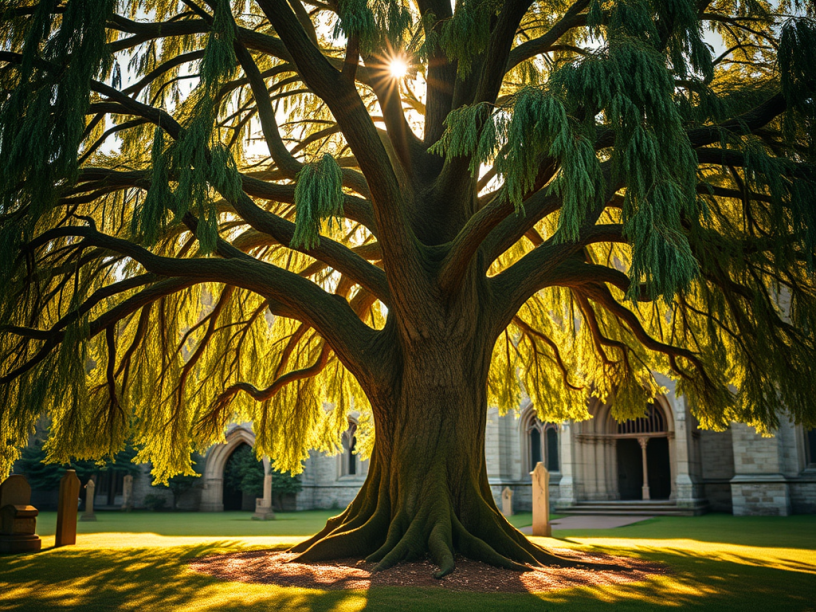

Author Joanne McFall explores how groves and trees were sacred to the ancient Celts and regarded as being bridges between the physical and spiritual realms.
Trees, groves and forests were of particular spiritual significance to the Celtic way of life and even more so to the lives of spiritual practitioners such as druids, healers, mystics and seers. While many trees had to be cleared to enable new communities to be be built and land to be used, many individual trees and groves associated with the druids and spiritual realm were left as they were. It is believed in Celtic folklore that the Celts even centred their religion in the forests.
There are countless numbers of individual trees and groves across Britain and Ireland that are still standing today which may once have been sites of religious worship and spiritual practices. The ceremonies and traditions of contemporary spiritual practitioners originated from those of their Celtic ancestors. Today many sacred groves such as Yew groves are enclosed within Church grounds, whether in ruins or still in use. Trees were regarded as having immense spiritual power and importance. Their branches reached high into the sky, their trunks were connected to the earth and their roots were connected to both the earth and the underground.
The circle was a sacred symbol in ancient Celtic belief which has survived in contemporary folklore from the passing down of superstitions, myths and associations through each generation. The druids had preferences for circular structures which they utilised in their practices. Groves such as yew, oak and hazelwood became associated with Druid ceremonies and particular groves became known as places of religious worship. Trees were believed to be both physical and spiritual abodes of sacred power, knowledge and practices. The tree could connect to both the tangible physical land and otherworldly realms instantaneously. There was an awareness that roots could reach deep within the earth and so have the ability to tap into unseen powers. In this way the tree was a natural bridge between above and below, between the seen and the unseen.
Ancient druid groves were known as nemetons which were the sole domains of these religious people most revered by the Celts. Many were inscripted with Ogham which may have marked their association with the druids and so were not to be interfered with.
Even though there are few archeological remains of druid groves apart from discovered votive offerings, inscriptions and shrines they will always be recognised in Celtic folklore for their great physical and spiritual importance. The area around trees and many trees themselves were believed to contain portals to other realms such as that of the deceased, the gods and the faeries. Given their close association with the spirit world it is interesting to observe how many Church buildings and graveyards have been built around or in close proximity to trees, particularly the yew, oak and ash in contemporary times. Even today just as in times past many people will not damage, take from or cut down trees in specific locations or that are believed to be connected to the spirit and faery realms.
As well as providing practical resources such as shelter, medicinal uses for healing and physical landmarks, groves were also places of transformation where particular individuals or the initiated could experience spiritual transformation. This may have taken the form of spiritual quest, invoking the surrounding natural essence or perhaps even in unique encounters with other realms. Belief in unseen worlds was a major part of Celtic life. This belief could effect or affect harmony and balance with the spirit world – something that was of great importance to the Celts and especially to the druids. In depth spiritual beliefs and practices were the domain of the druids in the ancient Celtic world. It may have been that people, for the most part, kept their distance or had to keep their distance from places and practices associated with the druids. Some ‘bands’ of druids may have initiated apprentices from outside of their circles while others may have remained closed. Trees and groves that were near or surrounded by water were believed to be of particular importance to the druids.
Water was both present on the earth’s surface but could also reach deep within the underground just like the roots of a tree. Many Celtic offerings have been discovered over the years in lakes and rivers throughout Britain and Ireland. As well as land and forests being removed to provide more living and farming space many forests and groves were also destroyed by Roman invaders. There have been many Roman accounts of ancient druid rituals and ceremonies that took place in groves such as those recorded by the poet Lucan. Although the druids and Celts were not always presented in the best of ways by the Romans it is clear to see from any account the great reverence and belief that they had in the natural world. This included many other types of landscape such as mounds and hills. Just like the tree and pools of water, the hill possessed the power to reach into the heavens, connect to the earth and provide pathways to spiritual realms and the underground.
Read more from Joanne McFall at beyondtheforestfloor.weebly.com
Picture: Large yew tree in the churchyard of St Peter and St Paul Church in Boughton, Kent. The tree has been traced back to its donation to the Church in 1695. Credit: Wikimedia Commons


