
As the British Isles welcome summer with dancing around the Maypole and fire festivals, Australia too will be marking May Day with both Anglo and Celtic traditions.
Dancing around the Maypole is a traditional folk dance that dates back centuries and is very much associated with English May Day celebrations. It is believed to have ancient pagan roots linked to fertility rituals.
The Maypole, typically a tall wooden pole decorated with ribbons, flowers, and greenery, symbolises the renewal of life and the awakening of nature after winter.
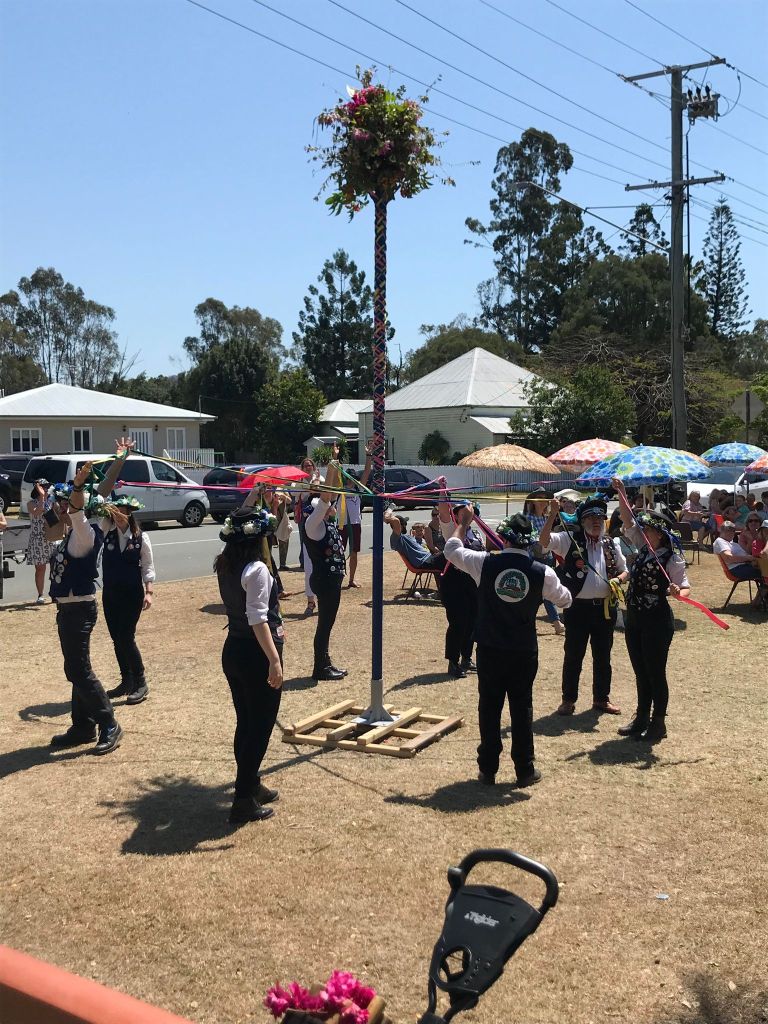
The dance itself involves participants, often young men and women, weaving in and out around the Maypole, each holding onto a ribbon attached to the top of the pole. As they move in opposite directions, the ribbons become intertwined, creating intricate patterns on the pole.
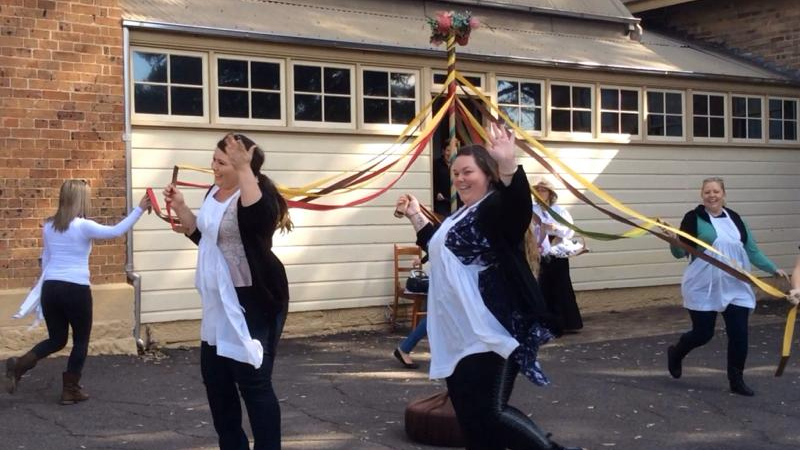
Once a common practice here in Australia, Maypole dancing has largely died out. One of the last Maypoles left standing in Australia is at the New South Wales Schoolhouse Museum of Public Education in North Ryde.
Gaye Braiding, Education Officer at the museum, told Anglo&Celtic: “We use a reproduction Maypole for our education program made from some re-purposed materials. To our knowledge, maypole dancing ceased as an activity in NSW public schools probably around the early 1980s. Prior to that there were booklets issued to teachers with instructions on the dances and weaving of ribbons.
“From the photographs we have seen, the ‘hey-day’ of maypole dancing in NSW public schools, and community events involving schools, seems to be between about 1870 and the 1940s.”
Westbury in Tasmania also has a Maypole. It is a permanent structure on the village green. The local school children dance around the Maypole during St Patrick’s Day celebrations.
While May Day is widely celebrated across England with Maypole dancing and crowning of the Queen of May, the practice is not as common in the Celtic nations. But one village in Ireland bucks the trend.
The Queen of the May is practiced in the County Cork seaside village of Whitegate.
The May Queen is a girl who rides or walks at the front of a parade on May Day. She wears a white gown to symbolise purity and often has a crown of flowers.
In Whitegate, young girls go ‘garlanding,’ or flower-gathering, in preparation for their Queen of the May procession, which takes place on the first Sunday in May. The tradition is thought to have been brought by British soldiers stationed at nearby Fort Carlisle in the 1800s.
At Whitegate National School, girls gather wildflowers to decorate the May bough, a mature, horseshoe-based briar and a traditional centrepiece for the parade. The May Queen, chosen from the previous year’s First Communion class, leads a procession through the village in her Communion dress, followed by local schoolgirls. They sing May songs and collect donations.
While the worship of the Goddess of Summer is at the root of the old May-time rituals, in Ireland, this evolved into Catholic Marian processions and May altars filled with flowers to worship Mary.
Now, ancient Celtic pagan festivals such as Beltane (Scotland, Isle of Man), Calan Mai (Wales) and Bealtaine (Ireland) are enjoying a resurgence.
Beltane is associated with the Celtic God of fire, light and the sun, Bel. Fires are an important custom at Beltane and people would leap over them to ensure their fertility.
Bealtaine will be celebrated in the Irish communities in both Sydney and Brisbane this April and May.
And Beltane Fire Festival at Rocky Creek Camp Grounds in Beerwah, Queensland will be held in November. Celebrations will include a feast, fire ceremony and Maypole dancing.
BEALTAINE & MAY DAY EVENTS
27 APR
Lá Bealtaine at The Gaelic Club, Sydney NSW
01 MAY
Dawn Morris Dancing, Mount Coot-tha QLD
Brandragon Morris Dance Up The Sun 6am, All Nations Park, Northcote VIC
06 MAY
May Day Monday with Morris dancers, Fox and Hounds, Wongawallen QLD
11 MAY
Queensland Irish Association Bealtaine, Finn McCool’s Fortitude Valley, QLD
Pictures: Main pic – Belswagger Morris in action with their travelling Maypole in Marburg, Queensland. Credit: Facebook/belswagger. Cover pic – Teachers embracing the Maypole at New South Wales Schoolhouse Museum. Credit: X@SchoolhouseMus

