
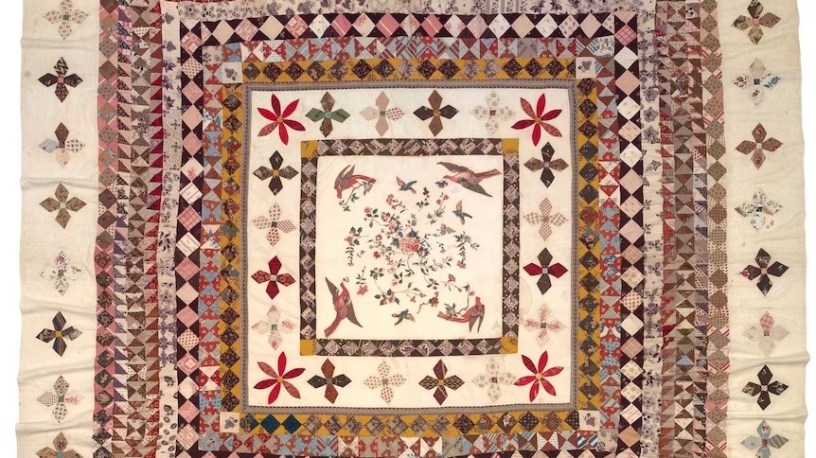
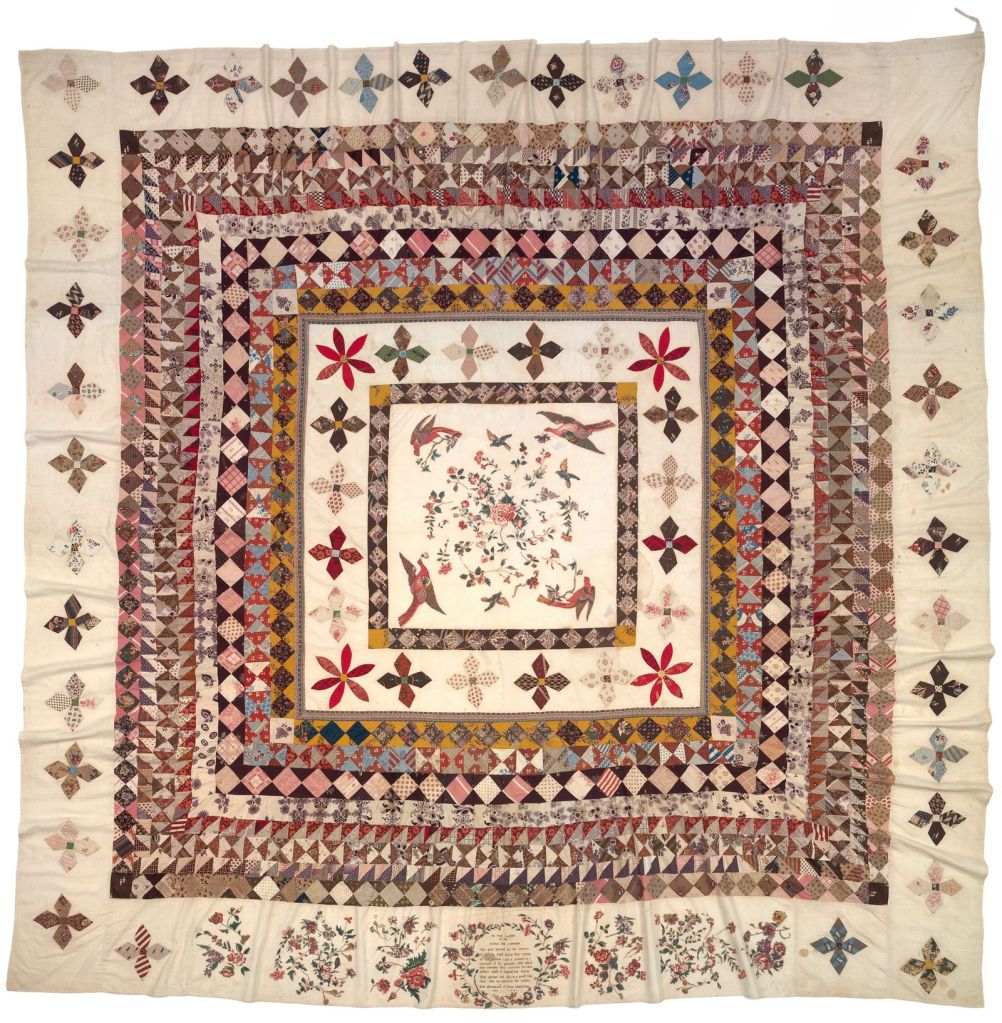
Soon to go on display in the National Gallery of Australia in Canberra, the Rajah quilt is a poignant symbol of Australia’s convict history. And it’s got a strange back story that involves vanishing for almost 150 years before showing up in an attic in Scotland!
This remarkable piece of work, created by convict women aboard the ship Rajah from England to Van Dieman’s Land (now Tasmania) in 1841, is a living artifact that reflects the resilience and cooperation of women in dire circumstances.
IN BRIEF
- Australia’s Rajah quilt vanished for 150 years before a surprise discovery in a Scottish attic.
- It was created by convict women in 1841 on the ship Rajah, travelling from England to Van Dieman’s Land.
- Quilting projects equipped female convicts with supplies to craft patchwork.
- The quilt’s 2815 pieces, adorned with intricate patterns, offer a peek into nineteenth-century textile artistry and technology.
- After an enigmatic stint in England, the quilt reemerged in 1987.
- It will go on display in the National Gallery of Australia in Canberra this month.
Quilting projects were initiated by reformer Elizabeth Fry, concerned by the plight of women prisoners in gaol and during transportation, she formed the British Ladies Society for the Reformation of Female Prisoners. The project aimed to provide useful tasks for female prisoners, keeping them occupied. Supplies such as fabric, wool, thread and needles were provided to women convicts being transported, including the 180 women prisoners on the Rajah, who made the patchwork quilt.
The stitched inscription on its border, dated June 1841, immortalises the convicts’ gratitude towards the convict ship committee for their welfare during the voyage to Van Dieman’s Land. Its 2,815 pieces showcase intricate patterns, offering a cross-section of 19th-century textile technology.
At some stage after its arrival in Tasmania, the quilt was returned to England, to be presented to Elizabeth Fry. Its life and ownership during the following 146 years is unknown. In 1987, the quilt mysteriously reappeared in an attic in Scotland. It was returned to Australia, where it found a home in the National Gallery of Australia.
This month, the quilt will be put on display at the gallery in Canberra. A Century of Quilts is an opportunity to see a special collection of National Gallery textiles showcasing the artistic expression of women from 1840 to 1940.
A Century of Quilts opens on 16th March and runs until 25th August. Entry is free. For more information and to book a ticket, go to https://nga.gov.au/exhibitions/a-century-of-quilts/
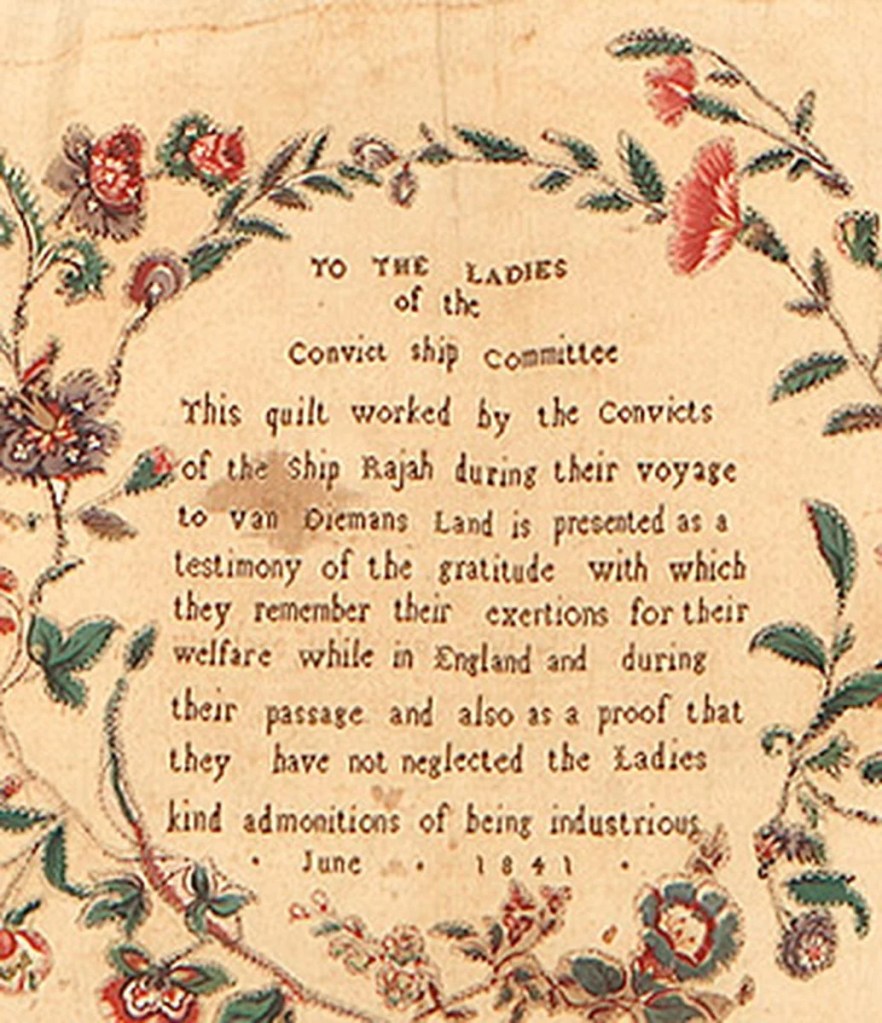
Kezia Hayter, Unidentified women of the HMS Rajah convict ship, The Rajah quilt, 1841, National Gallery of Australia, gift of Les Hollings and the Australian Textiles Fund, 1989, and a stitched inscription on its border. Pictures: National Gallery of Australia

