
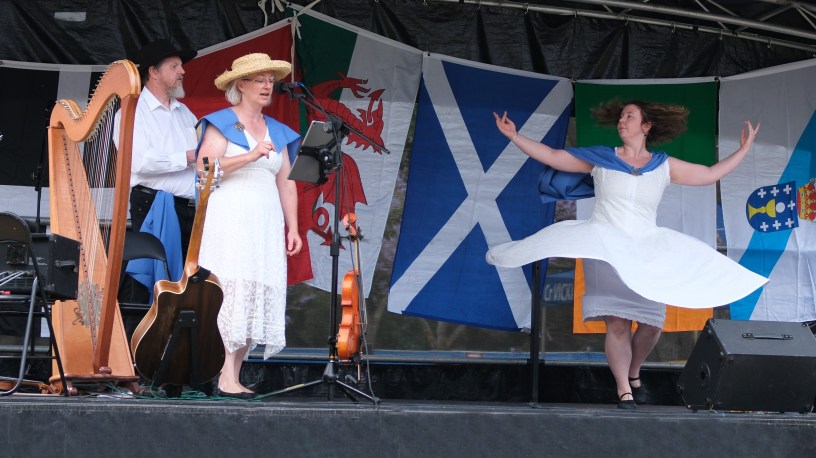
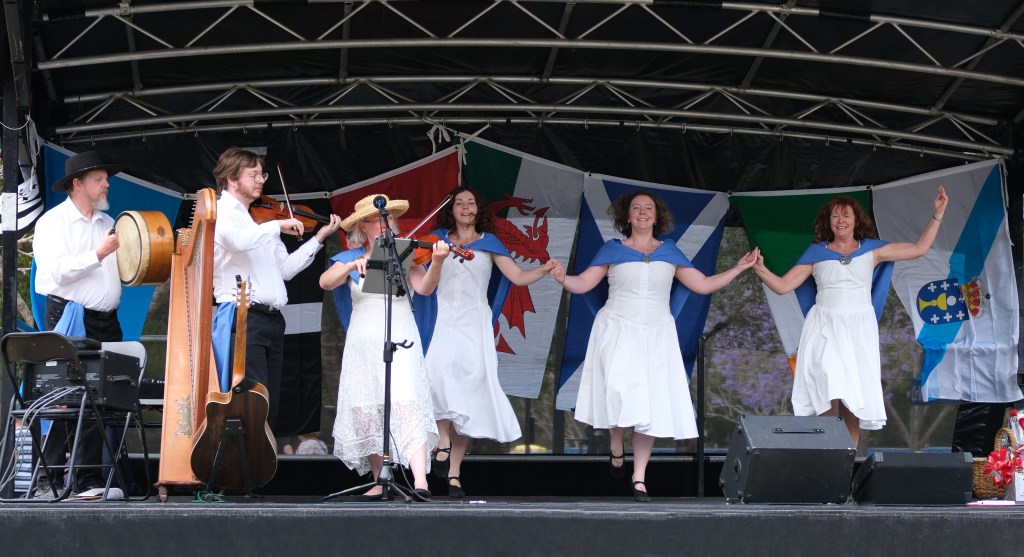
The opening of the Celtic Nations Standing Stones in Moorlands Park, Brisbane, featured a festival of talent from all the Celtic nations. Among the crowd favourites were The Manx Dancers of Brisbane. Their leader, Dr Heather Clarke tells us about the history of Manx dancing.
The Isle of Man’s dance culture seems to be a fascinating mix of influences. Can you tell us more about how what has shaped local traditions?
“The Isle of Man has a distinctive dance culture with Celtic, Norse and English influences. The Manx-Gaelic name for the island is Ellan Vannin (or Mannin). It is a relatively small island measuring 48km long and 16km wide, situated in the Irish Sea between Cumbria in Britain and County Down in Northern Ireland. The location of the island, being roughly equidistant from Wales, England, Scotland and Ireland, has led to the development of a fascinating amalgam of traditions in music, song, poetry, and dance.”
Have the people of the Isle of Man always practiced these folk dances?
“The local culture has not always been appreciated; by the 1890s it was in danger of being forgotten. The folk dances were regarded as inferior to the modern dances of the time, and had largely fallen out of favour. It was only at this time that a number of individuals travelled the island and identified surviving dances. The efforts of these collectors saved the dances from vanishing altogether. It was through the enthusiasm of (Manx cultural activist) Mona Douglas that these dances were introduced to schools in the 1920s. As the century progressed, traditional music and dance were included in the school curriculum, a key factor in keeping the culture alive.”
What efforts are being made on the island to keep its culture alive now?
“A highlight each year is the week-long Manx Folk Awards, a celebration of the culture where 1,000 children gather to learn, perform, and create new works in the traditional style.
Another major influence in keeping the dances alive is The Manx Dance Society. This group was formed in 1951, celebrated its 70th anniversary in 2021, and continues to teach and perform on the island and abroad. There are now an impressive number of other groups in the island: Skeddan Jiarg (Manx Gaelic for Red Herring), Perree Bane (White Jackets) Ny Fennee (The Heroes), Bock Yuan Fannee (Juan’s Flayed Horse, ie Shanks’ Pony).”
What resources have been made to help preserve Manx culture abroad?
“The Manx Government is keen to preserve and promote the traditions of the island, providing resources through the Culture Vannin website covering every aspect of the culture. The videos are especially useful for learning the dances and watching the performances.”
What distinct features does Manx dance have that sets it apart from others?
“Manx dances have a distinctive character: the arms are often held in a raised position, the Manx reel step features in most dances, and many include the cross-step motif – a series of movements repeated throughout the dance. They are fun, easy to learn, and usually quite lively! Certain dances are linked to the Manx calendar and celebrated on specific days: The Flitter Dance on Good Friday, at Harvest time the Babban ny Mheillea, Hop tu Naa on 31st October, The White Boys Dance in the Christmas period, and Hunt the Wren on 26th December. Other dances are purely social, and a favourite of ours is the courting dance Hyndaa Yn Bwoailley (Return the Blow).”
The Manx Dancers of Brisbane have a diverse repertoire. Can you share some insights into the different dances you perform?
“The performance repertoire of the Manx Dancers of Brisbane includes the Ladies Jig, Dance of the Yellow Flowers, Return the Blow, and the Dance for Three. We have two performance costumes: one represents the colours of the Manx flag – a red shirt and black skirt or trousers; the other costume is a white dress with a Laxey blue shawl and Celtic brooch, our men wear a white shirt, black trousers, and blue sash. Blue is the dominant colour in the Manx tartan, misty blue for the seas that surround the island. We have performed for the Manx Society in Brisbane, and recently at the unveiling of the Celtic Council’s Standing Stones in Moorlands Park. We hope to perform at the Glen Innes Celtic Festival in 2024 where the Isle of Man is one of the featured nations.”
Your role as the leader of the Brisbane Manx Dancers is quite impressive. Can you share your personal connection to the Isle of Man and how this heritage has influenced your interest in dance and culture?
“I am a dance historian with Manx ancestors – my great-grandparents (Curphey and Clucas) came from the Isle of Man and settled in Australia in the early 1900s. “I have a background in Scottish, Irish, English and Australian dance traditions, and training in classical ballet. I have always had a keen interest in my Manx heritage and I have visited the island several times.”
Dr Heather Clarke’s website presents many aspects of dance heritage in Australia, you’ll find it at https://www.historicaldance.au/
*This story was published in the November 2023 edition of Anglo&Celtic magazine

